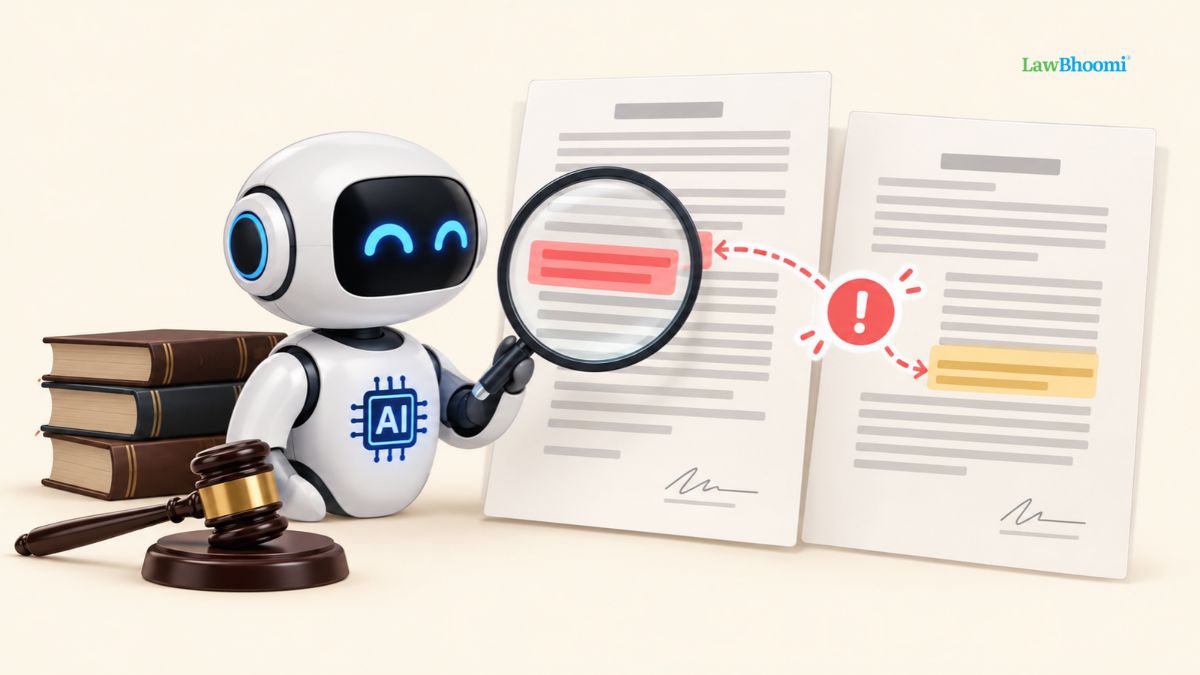
Yes, AI can help find contradictions in legal documents by comparing clauses, statements, dates, figures, obligations and factual claims across one or more documents. It can quickly highlight possible inconsistencies that may otherwise take hours to identify manually. However, AI cannot decide on its own whether every contradiction is legally important. You still need to verify the original documents, context and applicable law before relying on its findings.
AI finds contradictions in legal documents by reading the text, comparing related statements and identifying places where two or more parts appear inconsistent with each other.

Modern AI tools can process large amounts of legal text and look for differences involving facts, contractual duties, dates, monetary figures, names, legal positions and other important details.
For example, suppose a contract states in one clause that payment must be made within 15 days. Another clause says that the same payment must be made within 30 days. AI may identify these provisions as potentially contradictory and bring them to your attention.
This makes AI legal document analysis particularly useful when you are dealing with long contracts, case files, pleadings or multiple versions of the same document.
AI can identify several types of inconsistencies in legal documents. Some are simple factual errors, while others may involve more complicated legal interpretation.
AI can compare dates appearing throughout a document or across multiple documents.
For example, a legal notice may state that an agreement was terminated on 10 January, while an affidavit may say that the termination took place on 15 January. AI can flag the difference so that you can check which date is correct.
Date inconsistencies can become important in matters involving limitation periods, notices, contractual deadlines and timelines of events.
Legal documents frequently contain amounts relating to loans, damages, consideration, compensation or payments.
If a contract states ₹10 lakh in one section and ₹12 lakh somewhere else for the same transaction, AI can highlight the inconsistency.
However, you should check whether the two figures actually refer to the same amount. One may represent the principal amount while another may include interest, taxes or additional charges.
One of the most useful applications of AI for contract review is identifying conflicting clauses.
Suppose Clause 8 provides that either party can terminate the agreement by giving 30 days’ notice. Clause 17, however, requires 60 days’ notice.
AI can identify the apparent contradiction and point you towards the relevant clauses.
You must then determine whether one clause applies generally while the other applies only in a particular situation.
AI can also compare factual statements made in pleadings, affidavits, witness statements and other documents.
For example, a witness may state in one document that they reached the location at 8:00 PM, but another statement may suggest that they arrived at 9:00 PM.
Such inconsistencies may be relevant during legal research, case preparation or cross-examination.
AI may identify variations in:
Even a small difference can sometimes create confusion in legal documents. AI can help you locate these issues faster, especially where the same details appear dozens of times.
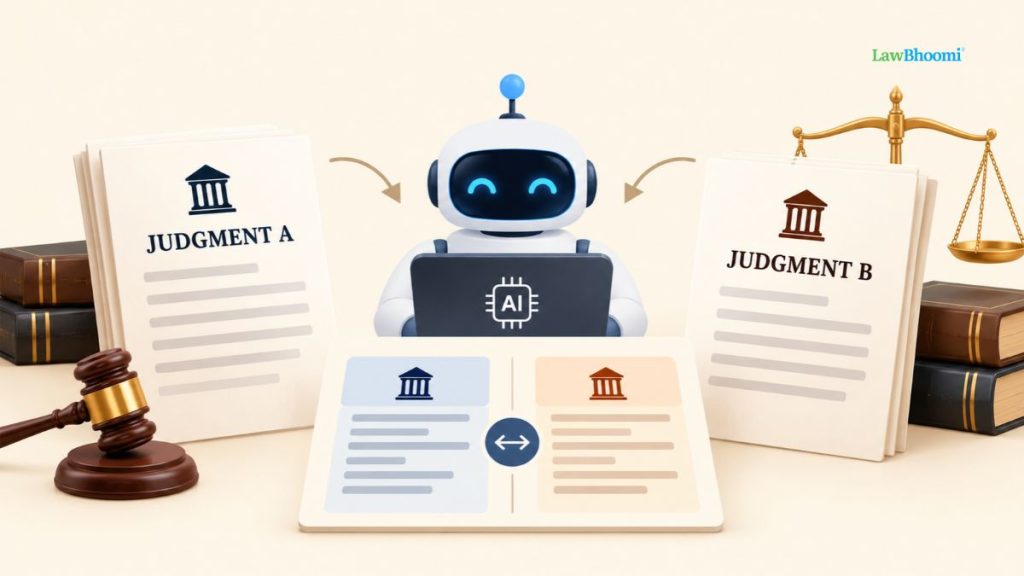
Yes. AI can compare two or more legal documents and identify areas where their contents appear inconsistent.
This can be useful when you are comparing:
For instance, imagine that a plaintiff states in the plaint that payment was never received. Later, another document filed by the same party mentions receiving part payment.
An AI tool may identify both statements and indicate that they need further examination.
This type of AI document comparison can save considerable time when dealing with a large case file.
Using AI effectively requires more than simply uploading a document and asking whether it contains contradictions.
Start by providing the documents that need to be compared.
If the issue concerns a contract dispute, this may include the original agreement, amendments, notices and correspondence. If you provide only one document while important information exists elsewhere, the AI may not have enough context to identify the real problem.
Confidentiality should also be considered before uploading legal documents to any third-party AI platform.
A detailed prompt usually produces a more useful result than a general question such as “Find mistakes in this document.”
You can ask the AI to examine:
You can also ask it to mention the relevant page number or clause number wherever possible.
One practical way to review the findings is to ask AI to prepare a table.
For example:
| Location | Statement | Conflicting Statement | Possible Issue |
|---|---|---|---|
| Clause 6 | Payment within 15 days | Clause 12 says 30 days | Different payment deadlines |
| Page 8 | Incident occurred on 4 May | Page 21 says 6 May | Different dates |
| Annexure A | Amount is ₹5 lakh | Affidavit says ₹6 lakh | Amount mismatch |
A table makes it easier to review each issue one by one.
Yes, AI can be particularly useful for finding contradictions in contracts because contracts often contain several interconnected clauses.
Long commercial agreements may contain provisions relating to payment, liability, termination, confidentiality, warranties, dispute resolution and performance obligations.
A clause added during negotiation may sometimes conflict with another clause that was not updated.
For example, an agreement may state that disputes will be resolved through arbitration in Delhi, while another clause may refer to arbitration in Mumbai.
AI contract analysis can flag such differences and help you identify provisions that require closer review.
However, not every difference is a contradiction. Different clauses may intentionally apply to different circumstances.
AI can also help identify contradictions in court documents.
This can be useful in litigation where several documents contain overlapping factual claims.
You may use AI to compare the contents of:
For example, if a party gives one explanation for an event in a notice and a different explanation in an affidavit, AI may flag the inconsistency.
However, whether that difference becomes legally relevant depends on the circumstances, the nature of the proceeding and the applicable law.
For law students, AI can make document analysis faster and more structured.
When working on moot court problems, internships, research assignments or case studies, you may need to compare several documents and identify inconsistencies.
AI can help you prepare an initial list of issues before conducting detailed legal research.
It can also help students understand how facts change across different documents. This is particularly useful when analysing long judgments or complicated moot propositions.
However, students should not copy AI conclusions without checking the source material.
AI is useful, but it is not completely reliable.
Two statements may appear contradictory even though both are correct.
For example, one clause may provide a 30-day notice period during probation and another may provide a 60-day period after confirmation.
AI might flag the difference unless it properly understands the surrounding clauses.
AI does not guarantee that every inconsistency will be detected.
Contradictions may be hidden in complex drafting, annexures, schedules, definitions or cross-referenced documents.
Therefore, manual legal review remains necessary.
Generative AI tools can sometimes provide inaccurate interpretations or even refer to information that does not exist.
You should therefore verify every quotation, clause number, page reference and conclusion given by AI.
Legal documents may contain privileged or sensitive information.
Before uploading client documents, lawyers should understand how the AI platform stores, processes and uses uploaded data. Sensitive information should not be placed into an unsuitable AI tool without considering confidentiality obligations.
AI is generally faster than manual review, but it is not a replacement for legal judgement.
A human reviewer can understand intention, legal significance, drafting history and surrounding circumstances in ways that AI may not always understand accurately.
The best approach is therefore to combine both methods.
AI can perform the first-level review and highlight possible contradictions. A lawyer can then examine those findings and determine which ones actually matter.
This combination can make legal document review using AI more efficient without completely depending on automated analysis.
If you are using AI to identify inconsistencies, a few practices can improve the quality of the result:
These steps make AI-assisted legal analysis safer and more useful.
No. Lawyers should not rely completely on AI to identify contradictions in legal documents.
AI can function as an assistant that speeds up document review, but professional legal analysis requires more than comparing sentences.
A lawyer must consider the purpose of each clause, surrounding facts, legal principles, procedural requirements and the importance of the inconsistency to the dispute.
Therefore, AI should help with identification, while the final interpretation should remain with the lawyer.
AI can help find contradictions in legal documents by comparing dates, amounts, clauses, factual statements and legal positions across one or more documents. It can make contract review, litigation preparation and legal research much faster.
However, AI should be treated as a supporting tool rather than the final decision-maker. Every contradiction identified by AI should be checked against the original documents and surrounding context. When used carefully, AI can significantly improve the speed and organisation of legal document review.